

A Defense of Appetite
Don't forget to be human.

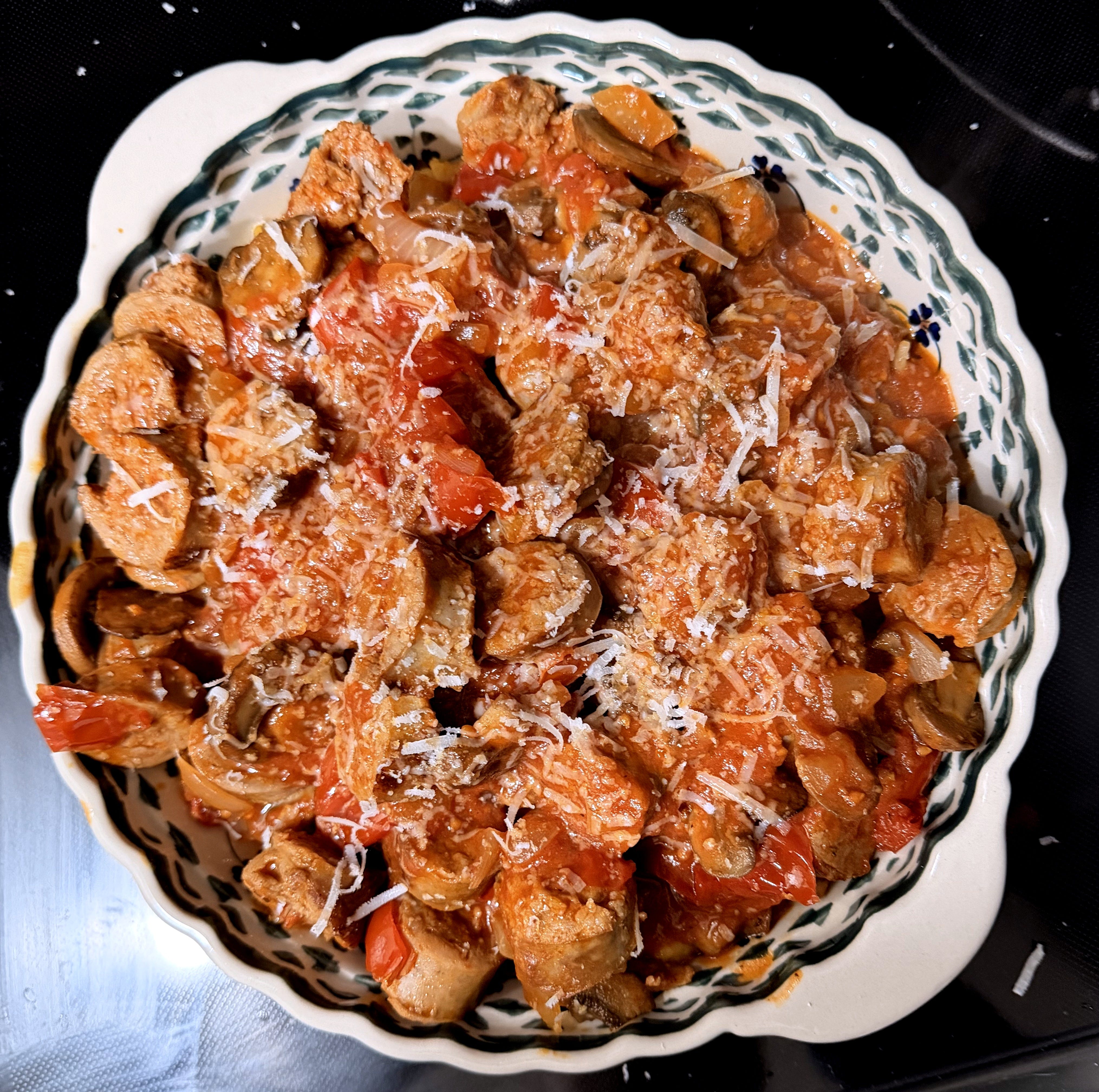
I cook quite often, primarily traditional Italian dishes (or my interpretation of them since some ingredients aren’t readily available). What stands out is that certain dishes require nothing but my presence for about three-quarters of the cooking time. I stir, taste, smell, and occasionally taste again, and maybe one more time. Cooking in this manner is likely the least efficient activity in my life. By every metric that society currently values, it only results in a meal (fuel, as the optimizers would like you to consider), and I’ve come to believe that this kind of cooking is one of the last places where I feel fully human.
I bring this up because I have read a few pieces on the “millennial midlife crisis”1 and my favorite is how it is forming a barbell: loud public optimization on one end, quiet retreat on the other, and a hollowed-out middle where impulse spending used to live. The detail that stopped me is about what’s humming underneath both ends. GLP-1 drug craze doesn’t just suppress hunger, they lead towards less craving generally. Less alcohol, less impulse buying, less of the itch, and arguably less fun. A generation is entering the statistical bottom of the happiness curve at the exact moment wanting itself became adjustable, and the open question, what a midlife crisis looks like with the craving turned down, is the most interesting question I’ve encountered this year.
I keep thinking about what happens to the human experience.
Wanting and liking are different machines
The behavioral science here is genuinely useful, so let me spend a paragraph on it. Wanting and liking run on separable systems in the brain. The research tradition behind this calls wanting “incentive salience,” the pull toward a thing, and it operates on different circuitry than the pleasure of actually having the thing. You can crave something you no longer enjoy, which every lapsed smoker already knows (and who I also just triggered their desire for a cigarette, sorry about that), and you can enjoy something you never crave. The systems usually travel together, so we experience them as one feeling, but they can be turned independently, and now, at population scale, we’re turning one of them.
Here’s what worries me about that, and it has nothing to do with the medicine itself. For people fighting metabolic disease or addiction, muting the wanting is mercy, full stop, and I’d hand the prescription over myself. What worries me is the ambient ideology arriving alongside it, which treats wanting as such, appetite in the broad sense, as a design flaw in the human being. Something to be managed down. And that ideology didn’t need the drugs to get started. The drugs just gave it a molecule.
We were already dimming the senses
Look at what optimization culture did to sensation before a single peptide shipped. Food became macros, and a meal became a delivery mechanism for protein targets. Sleep became a score you receive in the morning like a performance review from your own mattress. A walk became steps. Music became focus-enhancing background at 40 hertz. Wine became a toxin with a public relations problem. Every sensory channel a human has got converted from an experience into an input, evaluated by what it does for the project of the self, and the project of the self somehow never includes the self having a nice time.
Desai’s piece has an image from the retreat end of the barbell that I can’t shake: dopamine sites in South Korea, where stressed users browse fake restaurant menus and fill shopping carts they’ll never check out. The ritual of wanting, preserved. The object, deleted. She reads it as consumption with the acquisition removed, which is right, but flip it around and it’s even stranger. It’s appetite in a terrarium. We’ve built little enclosures where wanting can still run around safely, because we no longer trust it loose in our lives.
And between the optimization that quantifies every sensation and the simulation that domesticates every desire, a whole territory sits abandoned. It’s the territory where the finer things live, and I want to be precise about what I mean by finer, because I don’t mean expensive.
The finer things are mostly free and mostly skipped
The finest things I have access to cost almost nothing and demand the one currency the optimized life refuses to spend, which is undefended attention. A piece of fruit eaten over the sink or an espresso drunk standing up, as a punctuation mark rather than a fuel delivery. Better yet, a dinner that runs two hours because nobody ended it. These are not consumption in any sense a dashboard could register. Your VO2 max is unmoved.
My grandparents’ generation, southern Italians who had nothing by any modern accounting, were rich in exactly this and would have found our situation incomprehensible. Not the drugs, they’d have understood medicine fine. It’s the ideology, the quest for performance optimization over everything. The idea that hunger before dinner is a problem instead of the seasoning. The idea that you’d mute the wanting rather than point it at something worth the trouble. Sunday sauce existed because appetite was treated as an honored guest you cooked for, and the anticipation was half the meal, the wanting and the liking arriving together the way the systems evolved to fire2.
That’s the loss I think hides inside the health framing. Optimization promises you more life, measured in years and biomarkers, and collects payment in the texture of the days themselves. Sensation dulled on purpose, appetite managed like a liability, pleasure deferred to some future self who, if the pattern holds, will also be advised to defer it. You can end up with a longer life composed of thinner material, and no metric will ever flag the trade, because the metrics are what made it. Leading back to the question, is this what the human experience was ment to be?
Wanting better, not wanting less
Appetite, a capacity, serves as a guiding force. The culture’s current approach of medicating, simulating, and disciplining this faculty is akin to suppressing the very thing that draws us to the table, the journey, the person, and the task at hand. By suppressing it excessively, everywhere, we don’t achieve a calmer life; instead, we create a quieter one, similar to the tranquility of a room after the occupants have departed.
The alternative, as my grandmother practiced without a specific name for it, lies in intentionally cultivating desire. By reducing the number of objects, selecting them more deliberately, and savoring them without external aids, we can direct our appetite towards the kitchen sink fruit. In doing so, we invest nothing, optimize nothing, and experience the entirety of what others approximate with supplements and terrariums. The finer aspects remain within our grasp. They were never behind a paywall. They’re just incompatible with the dashboard, and the dashboard is winning, and I’d like to put in a word for the fruit while there’s still a constituency for it3.
https://www.nytimes.com/2026/04/25/opinion/midlife-crisis-fitness.html (paywall), https://www.thecut.com/article/older-millennials-midlife-crisis-dystopian.html (also a paywall), https://www.npr.org/2025/07/24/nx-s1-5475205/why-the-midlife-crisis-for-millennials-looks-different-from-elder-generations (not a paywall),

My grandmother’s relationship with hunger management was to yell to eat at anyone whose plate had visible open space. Her cohort’s biomarkers were a mystery to everyone including their doctors, and they sat at the table for three hours laughing, fighting, and eating too much.
I say this as a man who uses multiple health trackers and a personal agent runtime, so I understand that both of us are under monitoring. However, I’ve decided that some things should remain off the dashboard, and dinner was the first item to make the list.