

Biomarkers and AI Processing
"It's 'maybe' a tumor"

I’m sitting in a small, humid room in the basement floor of an office suite. The room is silent except for sounds of heavy breathing and the outrageously loud tv in the corner repeating the same commercial over and over again. “Did you know you can order multiple health test without a doctor’s order?” As I wait to provide my arm to give multiple vials of my blood, I wondered how many of the half dozen people here were without a doctor’s order? Because one of them was me.
I’ve taken the leap into the modern middle age behavior of let’s test, track, and develop more anxiety1. I have always had a complicated relationship with tracking my health. When I was more focused on athletic performance, ironically I tracked the least amount. I would log my workouts and maybe my food if I felt like something was off but that often ended up like a Trump speech, full of lies, half-truths, and an accusation of others that was really my fault2. But as I made less time for myself, I would go through ups-and-downs of health tracking. Steps, calories in, calories out, heart rate, oxygen levels, sleep scores, blood sugar—the list goes on.
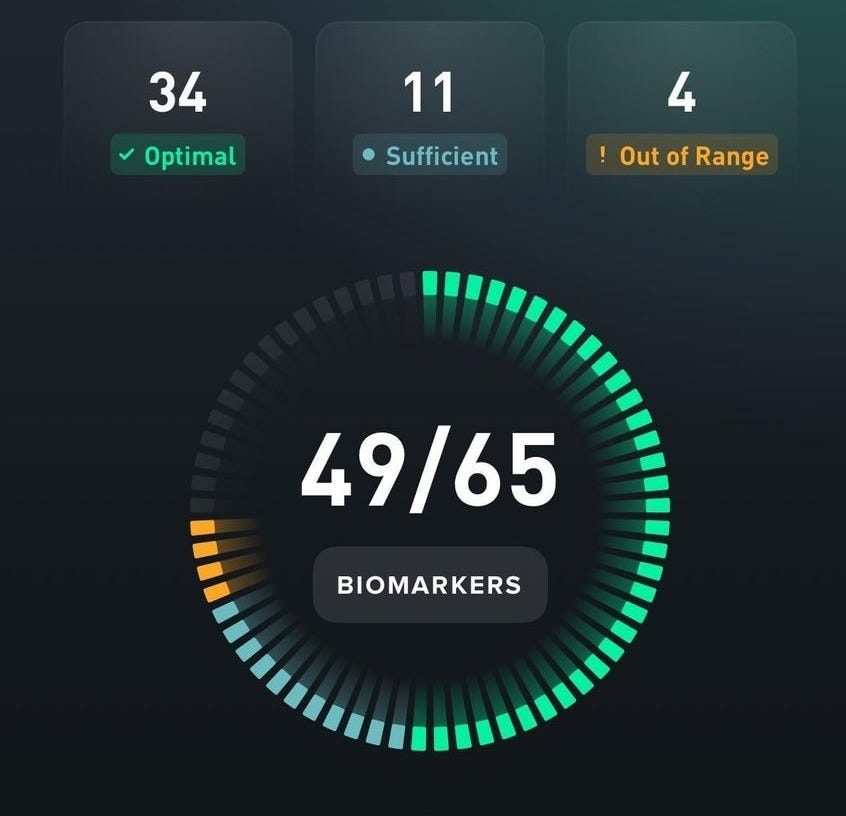
I’m not here to debate the effectiveness of this tracking, or even whether I’d recommend it to someone. My concern is bigger: if this data is being collected, who gets to access it? The natural place for this data processing is AI and the feedback on your results is potentially a worse privacy nightmare than the collection itself. A step count is just trivia. ‘This person is probably pre-diabetic’ is a product. In other words, raw numbers are just numbers until something interprets them. The feedback is the interpretation, and an inference about your health, that you might be anemic, pre-diabetic, or pregnant. All of which is far more valuable to an advertiser or insurer than the heart rate readings it came from. Technically speaking, your data might have been encrypted in transit and at rest, but now it needs to be processed, and the breakpoint for that data is AI. You can’t pass encrypted data to an LLM, which means the model owner can now see it. Do you trust these big LLM companies not to misuse this information? Do you trust them not to leak it?
I get why people go down this path anyway. It doesn’t always feel like there’s a right space for you to get help, so it’s understandable that you’d consider a system that both analyzes your results and gives you feedback. It seems appealing, especially in an age where it feels like doctors don’t care about you. You’re just an insurance billing number. These systems give you a chance to actually converse about your symptoms and hunt for a differential diagnoses. But those are traps, because again, where does this data go? What’s feeding these systems to produce that differential diagnosis? And are you sure you can process what comes back? Have you ever looked up abdominal pain? Google will hand you eight thousand possibilities, and four thousand of them sound scary and horrible.
An AI won’t give you all of those possibilities but it will convince you that it knows best. AIs are very sure of themselves. They would rather say something than admit “I don’t know” or “nothing.” So which anxiety is worse, 4000 potentially scary outcomes or 1 assertive outcome that could be wrong? You cannot always know if the model is returning accurate information. Now you’re in a weird spot: you gave up your data to be analyzed and you still have no clear answers. To be fair, you gave up your data when you searched Google too. (Why do you think you’re being served ads for iron supplements? Google thinks you’re anemic.) All of this tends to produce more anxiety because it never actually addressed the issue you had. You still need to see a doctor. The secondary effects of data sharing have not even begun to be understood. The long-term implications on whether your personal data can and will be used against you are in the near future.
Hopefully, anytime a new system gets built, it will actually be better at supporting you, but importantly, consider your privacy first. AI as a tool, AI as an augment, is wonderful. AI as a replacement is scary and anxiety-inducing, and it upsets people for good reason. I want systems to support you and protect you in the same breath, not as a settings toggle you find later. Until then, protect your information and choose carefully where you send it. The peace of mind is real, even if the abdominal pain is too. It's probably just gas.
Not that you know me, but I’m fine. This isn’t a stealth I have some major disease essay.
“This burrito clearly only has 600 calories (read as 1100). I only ate 2/3 of the cinnamon roll (I ate it all).” You get the idea.